India: Thoughts on beggars, poverty, and happiness

•June 12, 2011 • 2 Comments

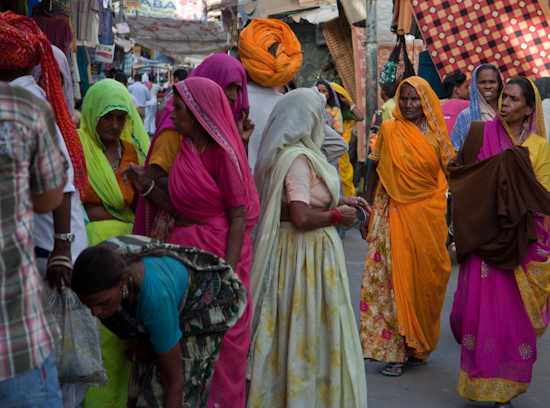
As a Westerner, and when in the more touristy areas of any city, there is a continuous flow of people selling and begging.   The adult men are mostly selling, but if you see one with a metal canister hanging from his arm, you can be certain he’ll ask for money.   Sometimes they want money for the sake of asking.  Other times they will wave their incense pot in your face and ask for a donation, other times they ask to have their picture taken for a few Rupees.
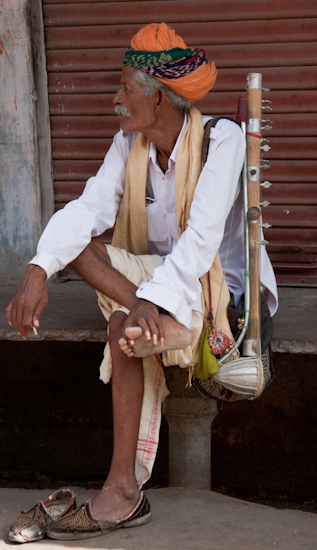
The taxi’s and tuk-tuk drivers are constantly asking if you want a ride.  But it’s the children that are the most difficult.  They are persistent and rarely take a gentle “no” as an answer.  In Pushkar the children put a spin on the religious nature of the city and say they don’t want money, they want food, and that buying them food will bring you good karma.  However, to actually buy them food, you would have to go to their favorite stall and pay the tourist price for whatever it is they want.  It’s a scam, but one that pulls on your heart strings a bit more than some old bugger selling a whiff of incense.

Dealing with the children has been an interesting challenge.  Giving in to them would be a never-ending situation, so that would not work.  They travel in packs, and I’ve seen what happens when a Westerner hands something over.  They communicate to each other like ants, and within seconds they are swarming around you.  No, that approach would definitely not work.

A firm, but affectionately delivered “NO” can sometimes work, but it has the negative effect of backfiring and making you feel like a mean old fart.  So, that would only be used in very extreme situations, and I’m trying not to do that at all.  Looking them in the eye and saying a gentle “no” can sometimes work only if you say it about a dozen times.

The latest approach is to stop (‘cause they mostly are hitting you up when you are walking), give them a long look while maintaining a smile and looking into their eyes, and tell them very quietly, “no, do you understand no?”  Give them a second to digest this before walking away, and then continue on.    It seems to work OK, and it appears to not leave a negative effect on either party.   I did this yesterday to one of the most aggressive and persistent little girls yet.  Then today another girl about her age, 13 or so, was trying to extract a few Rupees from me and before I had much time to tell her “no”, this girl from yesterday appeared and told her friend, in Hindi, essentially not to bother because I’m not paying.  I told her “I’m not paying”, and she said, “yes, I told her that”, and you know, she was smiling and not in the least bothered.  I guess I’m a marked man in Pushkar!
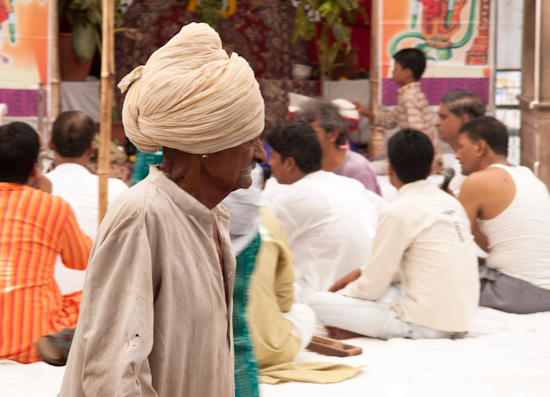

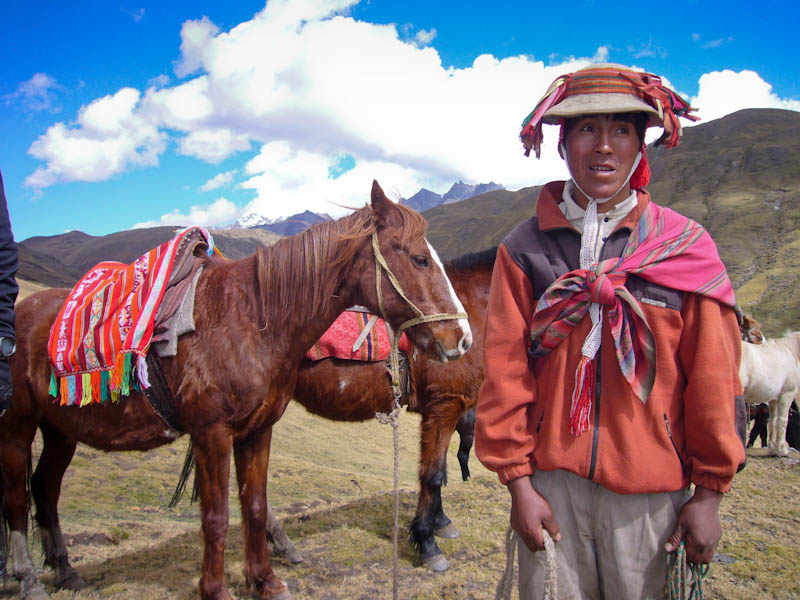
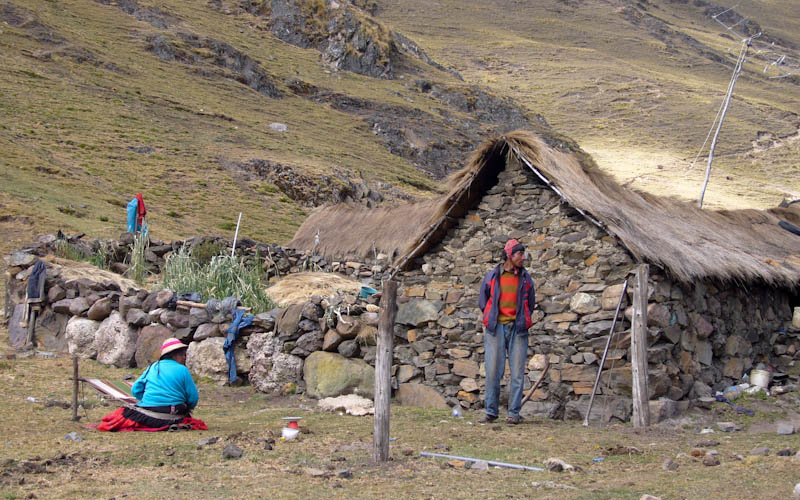
One of the other areas of concern in planning this trip was how to deal with all the poverty, because in all the places I’ve been, Tibet, Nepal, and now India, poverty is everywhere and constant.    And this poverty is not like the Peruvian poverty I saw when traveling there.  It’s much, much more severe.

One reaction is to feel guilty.  But I don’t.  How could I?  I didn’t cause this poverty, nor can I effectively do anything about it.   I don’t feel like I gained what I have through unscrupulous means and certainly not at these peoples expense.   There is another reality that strikes you after weeks in this situation, and those realities are that the majority of our planet – the vast majority – lives like this or worse (or maybe only marginally better).

Most of the people on Earth live one hell of a lot closer to this level of poverty, than to the level of affluence of anyone who’s reading this.   We have a very poor planet, and our affluent lives and abundance of material belongings are the extraordinary exception.
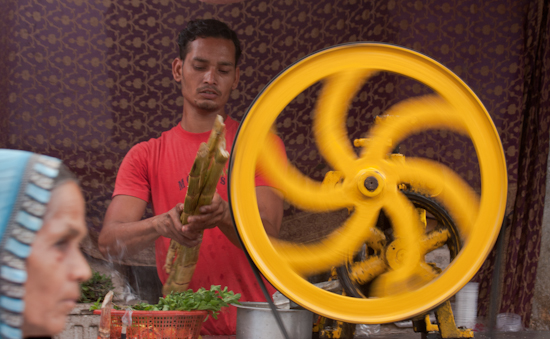
Extracting sugar can juice for drinks.

This then begs the next question, “Who’s happier”?   Well, I think it’s a safe bet that there would be agreement that all our stuff does not, on the whole, give us any certainty of happiness.   I think it’s a given that if you are looking for happiness from your possessions you’re guaranteed to fail in that endeavor.

As I say in the world of cycling, if you are keeping score, you can expect to be disappointed because someone will always be faster or stronger than you.   If you compare you to you, then if you want to be better than you were, you can work on that.    If you want to have more stuff, then you’ll never get there because by definition there is no end to that, and if you’re keeping score, there will always be someone with more who will make you feel like you have less.

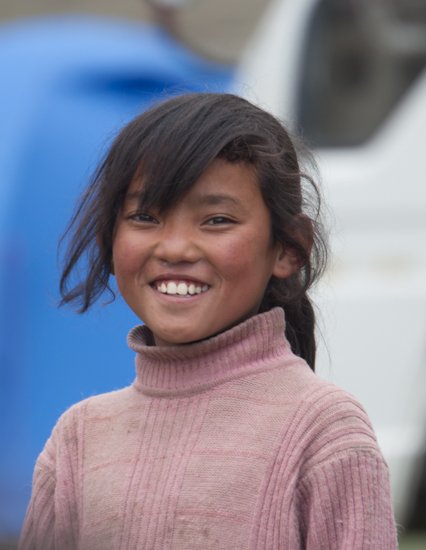
So, back to their happiness.   I have no idea if they are happy or not, but I can tell you this with absolute certainty, they don’t look any less happy then the rich Westerners I’ve seen in my life.   These people are friendly and give the most genuine smiles imaginable.  I never see those looks from people on the streets of the US.    This is their life, and while it’s not a life I would want, I have to say, they don’t look miserable.  I’ve seen people who appear far more miserable who have a LOT more stuff and a lot more living comforts.

This is the morning after of a traditional Indian wedding.  At first I though they were filming the latest Bollywood movie, then I thought it might be some corporate event, but no, an Indian Wedding.  Quite an affair.
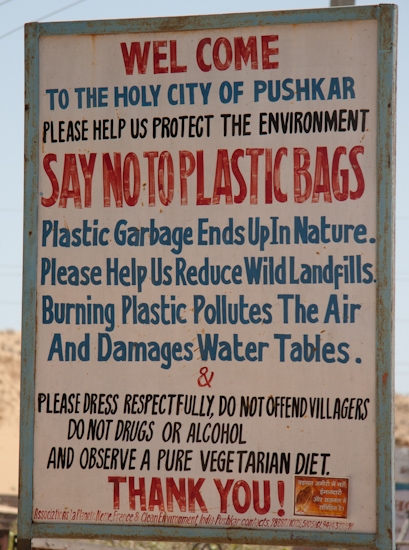
Pushkar: The Holy City, but don’t look behind those closed doors.

•June 11, 2011 • 1 Comment

Pushkar is filled with pilgrims that come to the lake to wash, pray, and make a good-luck offering to their families.   As I was walking to the lake, a man stopped me, asked where I was going, and when I said the lake, he gave me a small handful of flower petals.  He made sure I held them in my “lucky hand”, that being the right hand, and told me to go to the lake and make a wish for my family.

At first I thought it was MANG Pizza, then I realized it was supposed to be MANGO!

When I got to the lake, a Brahman took me by the hand and had me recite a long series of words that comprised a prayer offering.  He took my flower petals, mixed them with three colored pigments, and after much ritual, he put a yellow dot on my forehead.  He had me say a bunch of more words, and I put my flowers in the lake.  It was all very nice, until the subject of money came into the prayer offering.

He insisted I incorporate the actual amount I was preparing to commit into my prayer as part of my “good karma”, and “good luck wish to my family” (the more good karma one wants to have, and the more family members one wants to bestow good wishes upon, the correspondingly higher cost there is, apparently with this individual). Of course, anything I gave was up to me; the money was going to a charity (which seeing how it was all playing out, I happen to believe… hey, I got a receipt!).

He insisted I pay in US dollars, and he even had a recommended amount.  When I said I would pay in Indian Rupies, and I’d pay what I wanted to pay, he frankly got a bit testy for a devout religious person.  He then showed me what other westerners paid (from the receipt book), to which I said all very calmly and nicely, that didn’t really matter to me.  So, bottom line:  give what you want, the amount doesn’t matter, but really good karma comes at a price, and good wishes come at an even higher price, and the amount is variable based on which country you come from.

He put the string bracelet on my right wrist as a proof that I made my offering, and in the end, he seemed satisfied even though I fell seriously short on the financial amount.

Washing at the lake pools.

Suffice to say, Pushkar is a religious city.  No alcohol, all restaurant meals are strictly vegetarian, and may even be vegan as far as I can tell so far.   I didn’t know about the alcohol rule, and asked about it at the restaurant.  I was told I could have a beer brought to my room; however, I had to pay for it in advance, and someone would go outside the Pushkar city limits to buy it for me.   They even brought me a small refrigerator for my two-beer purchase.
After dinner I went to my room.  There was a knock at the door.  In comes the person I spoke to the beers about.  He has this huge bulge in his pants, and I can tell you it had nothing to do with him seeing me!  He steps in my room, closes the door, and removes two bottles of beer from under his belt.  In his pocket he had a small bottle of vodka for another guest.    When I asked about a bottle opener, he smiled and pointed to the large metal dangler hanging from my room key.  It’s a bottle opener, for Cokes, he suggests with a bit of a wink.
One of the many stairways down to the lake.

Cows, cows, cows….

Jaipur: The Pink City of Rajasthan

•June 11, 2011 • Leave a Comment

My plan was to take a train to Jaipur in Rajasthan.  But apparently, the Rajasthan train system is anything but reliable.  The trains tend to be very late, and all the trains were booked, so I was kinda stuck.  So, I switched to plan B:  I rented a car and driver to take me on a 9-day road trip.  This was surprisingly cheap, and given the unknowns of the train system, it seemed to be the most logical alternative.  I now have “a driver” who can not only take me to whatever town I want to visit, but can also drive me to the sights if I desire, and can take me to a restaurant if necessary.    Rajasthan in June is very hot, so having an air-conditioned taxi at my beck and call is pretty nice.

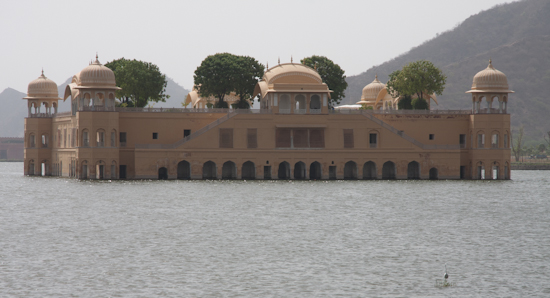
The Water Palace

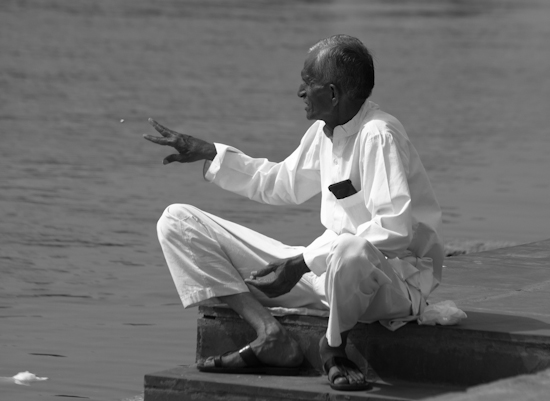
Feeding the birds at the waters edge.

My first stop is Jaipur, the “Pink City”. After my 5-hour drive here, I needed to take a walk, so I left the hotel in the scorching mid-day sun and walked towards the center of town.  I can see what must have been some spectacular buildings a few hundred years ago, no doubt a deeper shade of pink than exists now, after multiple decades of diesel exhaust giving them a fine, industrial sort of patina.

Street vendors providing a haircut and message for about $1.00

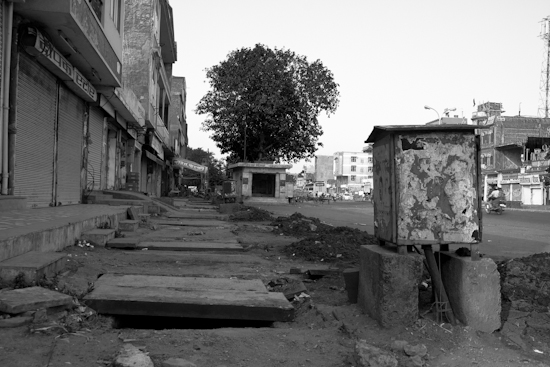
I was walking for about 60 minutes, and in that time I never saw one Westerner.  Suffice to say, this is not a big tourist town.  And I can see why.  Now if I said it was a bit of an “open sewer”, you might accuse me of hyperbole, or of using a metaphor to describe the place.  But no, there actually IS an open sewer.  There is this concrete trough that runs parallel to the road, which is normally covered with concrete panels with spaces about every 18” or so, which sometimes makes the “sidewalk”, and sometimes it’s between the sidewalk and the road.  And through it flows the effluent of the city.

This was not pretty.

Which means in the best of times (whenever that is) the open sewer is a least partially hidden by small concrete panels, but that would NOT keep the smell hidden.  However, today, and I’m guessing it was because of last nights torrential downpour, there were dozens of workers down in the trough, shoveling out the sludge that obviously became clogged overnight.

So in today’s intense heat, instead of the waste flowing below grade, it was sitting in heaping piles along the road.  Walking along, it was a real challenge keeping myself from gagging.  The smell was overpowering, but no one other than me seemed to notice.   This is not the Rajasthan of the travel brochures.

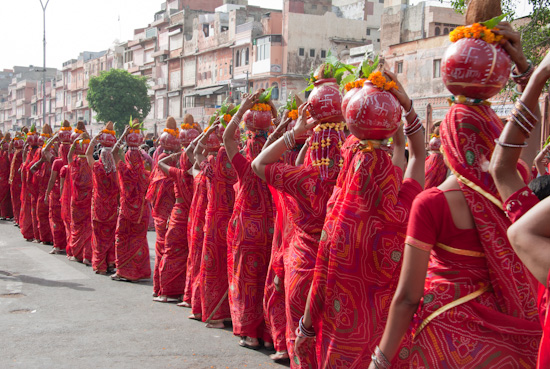
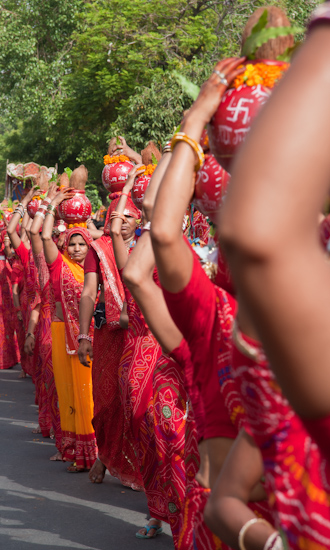
Then, I saw this parade.  There were hundreds of women, dressed in flowing red clothing, balancing clay pots on their heads.  At the front of the procession were a few camels properly decked out for the occasion.

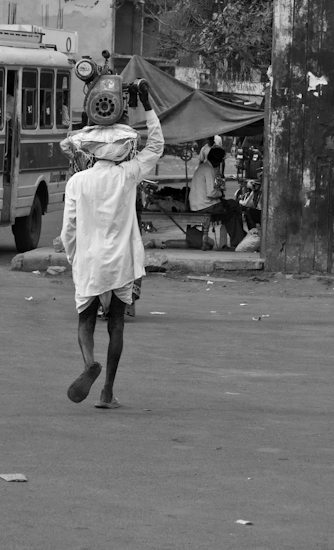
Balancing an engine on his head.

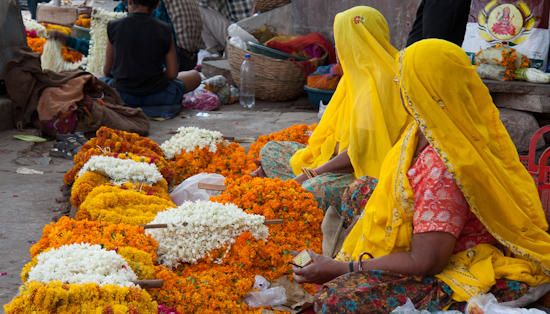
Flowers for sale

New Delhi: only by Kathmandu standards could Delhi seem relatively calm

•June 11, 2011 • 1 Comment

Leaving Kathmandu on a flight to India is, well, different.  On a completely full plane (six seats wide, and 35+ rows long) there were about 6 Westerners.  Security at the Kathmandu airport is large in quantity, but short in thoroughness.   I had my bags either screened or hand-searched at least 5 times from the time I stepped into the airport to the time I boarded the plane.  The last bag search was at the bottom of the stairs to the aircraft.   However, all of them were part of the rushed mayhem that is characteristic of that airport, so consequently, the search was perfunctory at best.

Signs clearly said that no more than 100ml of liquids could be brought on board in a container.   Though, when asked about my aluminum water bottle, which was half full, I said, “it only has a few sips of water”, which seemed to be an acceptable answer.

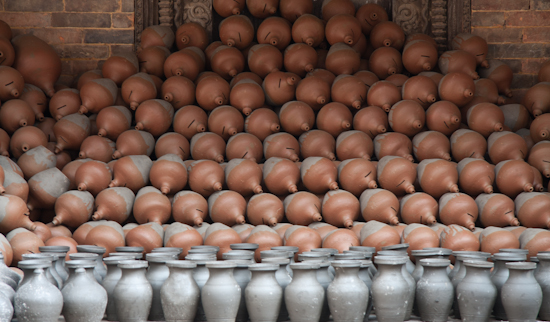
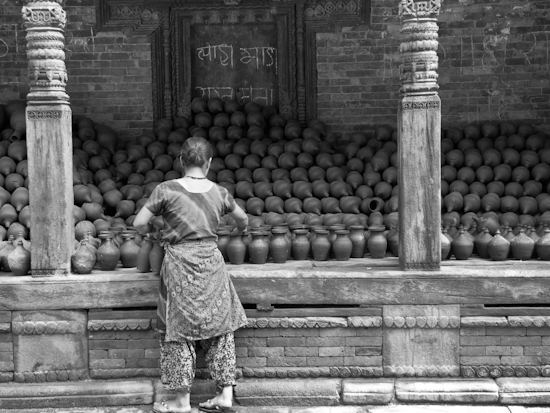
Pots in Kathmandu in the pottery district of Bhaktapur. Saw lots of clay, saw unfired and fired pots, saw an huge earthen kiln, but couldn’t find anyone actually throwing a pot.


The first time I took a taxi from the Delhi airport to the hotel was at the very beginning of my trip, almost a month ago.  This was the same ride to the same hotel.   But, unlike the first time, this ride seemed absolutely calm, which is only in comparison to, a) my prior 4 weeks, and b) just spending a few days in Kathmadu, which is insane by any standard.


June 7, Last Cycling Day, #18: The final stretch into Kathmandu

•June 9, 2011 • Comments Off on June 7, Last Cycling Day, #18: The final stretch into Kathmandu

After yesterday’s grueling ride, I wasn’t looking forward to the slog into Kathmandu; however, while the ride in was intense, it was tolerable. It was only 20 miles, but the closer we got to Kathmandu, the more we shared the road with cars, busses, trucks, and motorcycles. By the time we were inside the city proper, it was the usual mayhem, but we made it to the hotel without incident.

This type of cycling takes a tremendous amount of concentration… not on the actual cycling mind you, but on everything else, and on your own mission. If one does not cycle aggressively, you would never get anywhere. But we’re done.

All told, over 750 miles, 18 days of cycling, over 60,000’ of climbing, 5 passes exceeding 16,000’, sleeping at 15,000’ to 16,000’, sick once, lost 6 pounds (not good, and I’m eating like mad to put it back on), and it was overall, a fantastic experience.

I’m now in New Delhi, and plan on traveling in Rajasthan for a few weeks.  Cycling is over, but this will most certainly be a whole different experience.

Morgan Freeman’s brother in Kathmandu.

One of the thousands of interesting people on the streets.

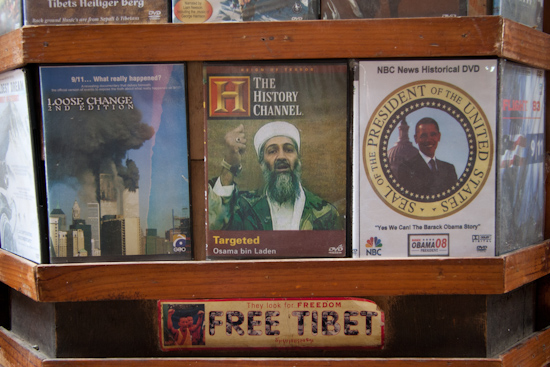
Checkout this DVD rental window.  You got some of the hot US political topics in three DVD’s:  911, Bin Laden, and Obama.    Speaking of Obama, he certainly is popular around here.  I was on one of the remote passes in Tibet, miles from anywhere, and a person asks me where I’m from, and I say the USA, and he say’s, “Obama!!!”, the people in Nepal, Tibet, and India love him.  They love giving you the thumbs up and saying “Obama!” It’s quite something.  I doubt I would have heard that 5 years ago about Bush.

Lhasa to Kathmandu, 5/ 5, Cycling Day 16: 9,100’ of continuous downhill… wheeeeee!!!!!!!!!!!!!!!

•June 9, 2011 • 5 Comments

The descent was from 13,600’ to 4,500’ over the course of 47 miles.  We started our morning on the cold arid plain of the Tibetan Plateau surrounded by snow-covered peaks.  By lunchtime we were in a lush, humid jungle overgrown with vegetation and a cacophony of tropical forest sounds.  The contrast from this morning is astounding, and welcome.

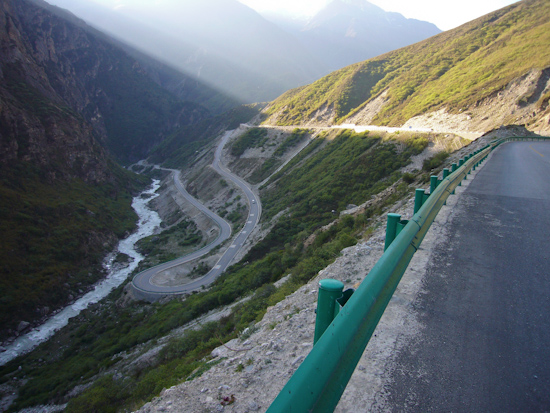
Follow the road with your eyes, it’s the most unbelievable downhill ever.  Great road, serene canyon, no cars, and down, down, down.

Our drop was through a steep river canyon, the base of which remained in shadows for most of the morning.  Every 1,000’ of decent brought with it a change in climate zone.  First we started seeing low shrubs and wildflowers.  Then we saw trees (our first trees in almost three weeks).  The sounds of birds became more and more pronounced as my altimeter spun lower.

The road just goes and goes and goes.  The road looks like it’s bottoming out, but it’s not.  It just keeps going down more and more.

Broad leaf ferns were growing at 9,500’.  The air became more humid, and for the first time in weeks my throat was not sore from breathing in the bone-dry air of the high Himalayas.  A layer of clothing was shed every 3,000’.

Further down we went; the smells of the damp jungle was a welcome change from the no-smell of the plateau.  The smooth road surface was free of traffic, so we could fly to our hearts content, only stopping to take in the surrounding remote beauty of the shear canyon and boiling rapids below.

Staying focused on the road, the canyon, and the newly changing sensations made for a perfect cycling experience. The fact that my fingers were cold at the beginning of the decent was only noticeable for a few seconds, then staying intensely focused on the experience made that become a minor feeling that would fade away to insignificance.

Porters carrying the contents of trucks across the border to Nepal.  Most trucks are not allowed to make the crossing.

Then, as we were ready to enter Nepal, we were woken from our cycling nirvana to the harsh contrast of the quiet canyon to a quintessentially awful Chinese boarder town.  Crowded, smelly, dirty, and an architectural nightmare.  There was a line of about 50 trucks queued up at the border, which took up one lane.  The other lane was a long line of women porters hauling the contents of the trucks over the border to another truck on the Nepalese side.  Certain vehicles are not allowed (ours was one such type, and I have no idea how it’s defined) to leave China, so porters are hired to ferry the contents across the border.

We had to go through Chinese customs to leave and consequently to show our passport yet again.  Then we had to show it again just before we stepped off Chinese soil just in the event that we turned into someone else in the previous 5 minutes.  Then, we had to get a Nepalese Visa, more showing of passports, and voila, we were across!

The Nepalese side of the border was worse.   More poverty, strikingly worse roads, but I have to say, and maybe I’m imagining it, the Nepalese seem one hell of a lot friendlier than the Chinese.  The Tibetans are very friendly as well, but there are precious few of them relative to the huge influx of Chinese into Tibet.

Notice the suspension bridge.   Our resort is on the other side.

We’re spending the night at The Last Resort.  It’s a fixed tent complex with hot showers, a bar, and restaurant, and the very famous Bungy Jumping off the 550’ high foot-bridge that spans 300’ across the raging river below.   I cycled across the bouncy and wobbly bridge, and can say that under no circumstances would I even consider for one nanosecond jumping off it.   Insanity is a perquisite as far as I’m concerned.

I will NOT be jumping off this bridge!


Looking down.  People actually bungy jump off this????

My afternoon will be spent sitting in this chaise lounge overlooking the lush canyon in front of me, feeling the breeze, listening to the cicadas, and keeping my feet firmly planted on the ground.

The jungle came more alive when the sun dropped below the canyon walls.  Noises from the banana trees that I could not identify, praying mantises flitting about, and a wall of noise “out there” that grew louder as the sun set further.  Then came the rain.  This environment does not get green by fertilizer.  It rains, and when it does, it comes down in solid sheets.  Our tent structures had metal roofs, and the roar was deafening, and fantastic.  Then, in the morning, it was sunny, clear, crisp, and the leaves were dripping from the evenings deluge.

June 1-4, Cycling Days 12-15: Everest Base Camp, A Town of Dogs, and Two Passes over 16,400’

•June 8, 2011 • Leave a Comment

June 1: It was a short ride today of only 24 miles, and our maximum elevation was 16,750’ at the checkpoint to Everest Base Camp.

For some unknown reason, we had to hand over our passports, yet again, to go pass the checkpoint to the Everest Base Camp.  This was the second checkpoint along the short and remote road from Rongbuk.

Then, the Chinese Military, in another example of their arbitrary, on the spot rule making, told us we couldn’t go more than 100 ft. beyond the checkpoint, and no, we could not walk beyond two large mounds about 30 feet tall and 200 feet wide with a small building atop that is just in front of us that would have allowed us to actually SEE the Base Camp.   No, not today.

The Chinese Police deleting images and confiscating a flag.

The other thing we were warned about is bringing any flag to pose with at the small monument for the Base Camp.  Apparently it’s a thing to do, and the Chinese Military don’t like it, for reasons that no one fully understands.   Well, as I stood there, a Chinese woman walked up to the small monument and posed with a red flag that had a bunch of Chinese writing on it.  Someone else photographed her.  Not good.

A military guard bolted from his tent and ran up to her, yanked the flag from her hands and grabbed the camera.  After much back and forth, the photographer was forced to delete the offending images.

As I stood there, watching this display and thinking about all the controls on our movements, I couldn’t help but think about all the Chinese who come to America and have free reign of the place.  No checkpoints (once in), no restrictions on holding a flag of their choice, no mindless and arbitrary controls over simple movements.  And most importantly, no sense of fear that if you mistakenly do the wrong thing that you’ll be incarcerated.

After leaving Base Camp, we then rode down to our campsite, the best one yet:  elevation 15,162’, but it feels like we dropped thousands of feet from the environment at Rongbuk.  The camp is along a stream, on a very small quite dirt road, and has a grassy flat area for us to settle for the night.   We got into camp early, so it’s a good laundry day.  There are clothes everywhere.

A long gradual climb.

June 2: Today we “only” rode 42 miles; however it was a real mixed bag.   The first portion was a fantastic 8 mile climb of about 2000’ topping out at 16,750’ on nicely packed dirt road with amazing views of the snow capped Himalaya’s.   I could have ridden that portion over again.  After that we had a rapid undulating downhill that taxed everyone’s bike handling skills.   I loved it.

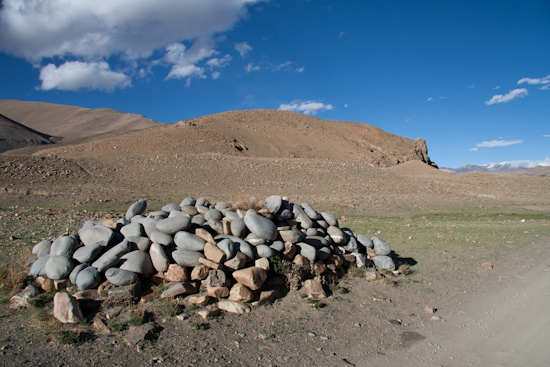
Piles of rocks with meditation mantras carved into them appear in the most remote of places.


However, after lunch, we slogged down a “road” for 20 miles that followed – no was IN – the massive riverbed.  The surface was made of large worn river rocks and sand, resulting in 20 miles of rock pounding torture that followed the excellent first portion.  The only good thing was that we had a screaming tailwind.  At one point I stood up on my pedals and acted like a spinnaker letting the wind push me along, and it did at a pace that without the wind I would have been hard-pressed to match.  My arms felt like two pieces of overdone spaghetti from all the pounding.  I’m not sure I can lift a beer; though, I will certainly give it a try.

A lone stretch of road out of Tingri.

The rocky-riverbed road ended in the town of Tingri, where we rode on a paved surface for 8 miles to camp.   Tingri is known for it’s large quantity of mangy dogs.   Now THAT’S something to be known for!  There were dogs everywhere.  Before I left on this trip I read several resources that said the dogs in Tibet are wild, rabid, and mean.  Well, I can say – and not a great lover of dogs – that they may be wild, and they may be rabid, but they certainly are not mean.  On the contrary, they are afraid of their own shadow.  They skulk away from you way before you think you might need to make one get out of your way.   The only difference in Tingri is yes, they are mangy, and they are everywhere.  I never saw so many nasty looking dogs on one street.

June 3: The ride today was short (40 miles), and flat (as in dead).   However, I didn’t ride it.  Me and one other rider developed a case of “travelers tummy” in the night.  We ended going with the truck directly to camp where, once the tents were up, I immediately laid down.  I spent the morning and afternoon napping and running to the toilet tent.  Fortunately my bug was isolated to the lower intestine.

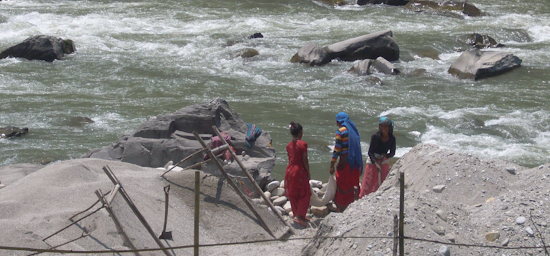
The women in Nepal are always dressed very nicely, wear jewelry, and look very smart.  Even if they are working in the gravel pits.  It’s quite a remarkable thing.   The men, however, don’t put the same effort in their appearance.


June 4:  Unfortunately I only rode one climb, and the one downhill.  Yesterday surviving on a half bowl of rice and some water did not give me the strength to do the second pass, and more importantly, did not give me what I needed for a 25 mile finish with a grueling headwind.

Lhasa to Kathmandu, 5/31, Cycling Day 11: Rongbuk: The worlds highest Monastery

•June 8, 2011 • Leave a Comment

Today’s distance was only 22 miles, and we only climbed 2000’; however, the road was dirt, rocks, and washboard.  We finished at the Rongbuk Monastary, which is at 16,400’.  We make camp here, so this will be our highest nigh sleeping on the trip. This campsite puts us 5 miles and 300 feet below Everest Base Camp.

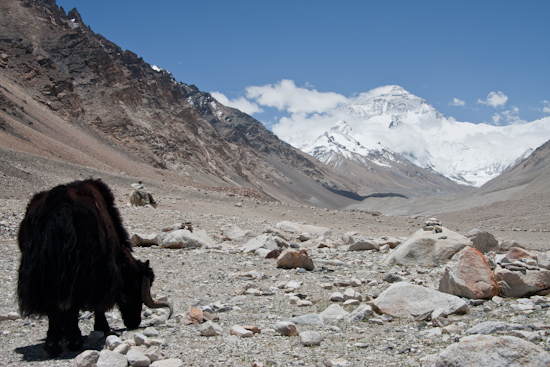
Yak’s laden with gear heading to Everest Base Camp

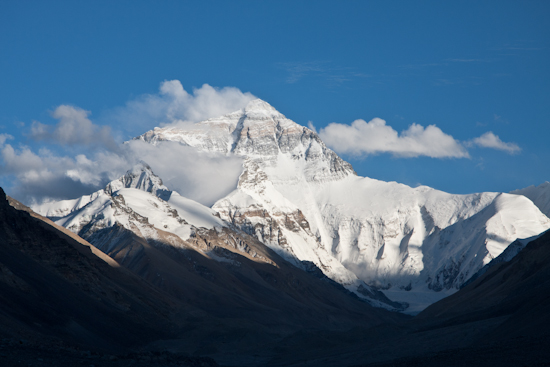
The weather today was perfect, except when we were about 4 miles from camp, and we faced the legendary wind off Mt. Everest.  The ride was more than rewarded by our view of Everest from the campsite.  The mountain is often covered in clouds, and the group that was here in April were unfortunately, faced with an obscured Everest after that grueling ride. For us, the mountain was right in front of us in all its spectacular glory.  It’s truly an amazing sight.

Everest at sunset.

The camp however, is not great.  The wind coming down the valley from Everest collects speed and cold, and by the time it reaches us, it’s a steady 40+ mph that’s cold and relentless.  When outside, a down jacket is required even though the sun is painfully intense and harsh at 16,400’.  Going into the tent is no relief because the solar gain is collected inside the tent, which makes it at least 90 degrees or more inside.    Bake inside, freeze outside.  The only place of moderate temperature is the dining tent, which is where I write this.

Our camp, with spectacular views of Everest.

The Ronbuk Monastary sits behind our campsite.  It’s the highest monastery in the world, and is very much a working monastery.  These are some very dedicated monks.

A monk pouring hot water on the floor to then broom it clean. Their sleeping cots line the room.

After dinner several of us went to the restaurant to have a beer in the only such place that can claim to have a view of Mt. Everest.   It was my highest beer, at 16,400’.   Lhasa beer comes in large sizes, about the equivalent of two normal bottles.  We split one between the three of us.  Two small glasses of beer was plenty.  The room was heated with Yak Dung, so that smell mixed with clouds of cigarette smoke was almost too much to take after a while, so we braved our way back to the tents.

Everest at sunrise

Cycling Lhasa-Kathmandu, 5/30, Ride Day 10: Seeing Everest for the first time

•June 7, 2011 • 2 Comments

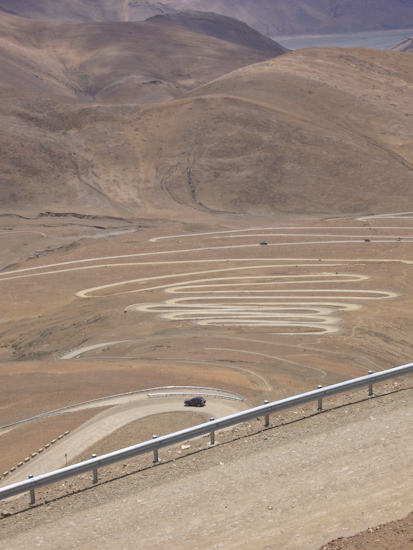
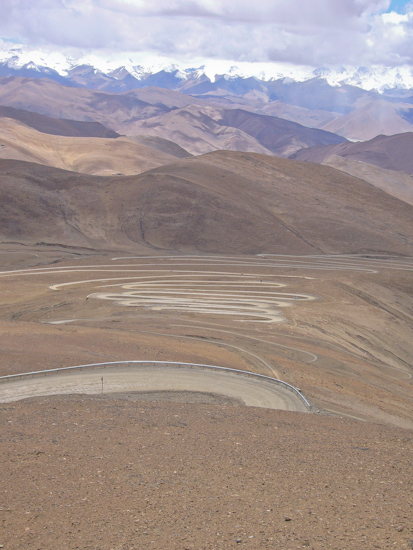
Today we rode 50 miles, most of which was on a dirt road.  The climb was 17 miles, with a gain of 4,000’.  I never in my life saw so many switchbacks.  Ever. When we reached the summit our elevation was 16,980’.

The climb today was, in terms of distance, elevation gain, and total elevation not too far off yesterday, and today we rode on dirt.  But today was much easier and enjoyable.  Mostly due to the fact that there was almost no wind, my cold is about completely over, it was warm and sunny, and the scenery was far more interesting.

Then there was the downhill.   It was amazing, with more switchbacks then the uphill side as we descended 3500’ over 8 miles.

 A fantastic downhill ride.

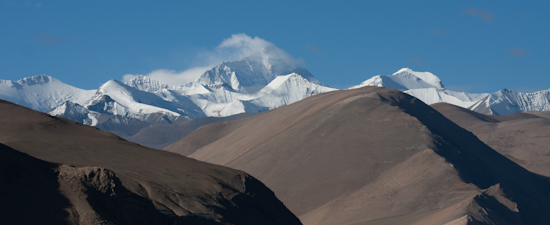
All the while, during the downhill, we were blessed with a view of the Mt. Everest mountain range.  The sight was unbelievable, and it was difficult to keep an eye on the road with such a spectacular view right in your face.

Mt. Everest is one of the most spectacular natural scenes I’ve ever laid my eyes upon.  Superlatives do it no justice.

This is not the best view we had, just one of the first.  When we slept near the Base Camp, we had an amazing view of Everest that I’ll post later.

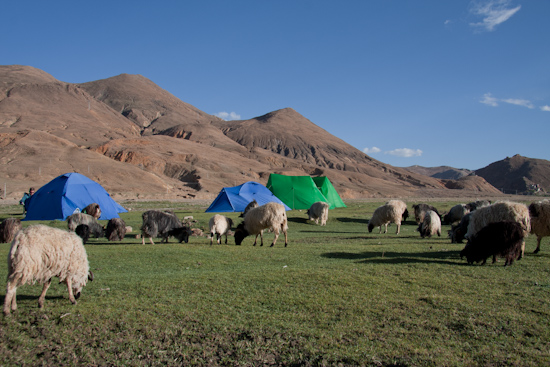
Tonight is another night camping.  Right behind our tent is a glacial stream with its aquamarine, frigid waters making a serpentine cut through the grassy sheep grazing pasture.   This is the view from my tent.

May 29, Ride Day 9: Cycling to 17,080 ft.

•June 7, 2011 • Leave a Comment

The ride today is only 45 miles, but we have our biggest climb yet, topping out at 17,080’. We camp today at 14,500’, our highest so far.

Today was one of the most difficult cycling days I’ve ever had.  There were several factors that made it hard.  First, I was just getting over a cold, and had yet to fully recover.  Second, we climbed 3600’; though, that in itself is not a big deal, but ending it at over 17,000’ made it hard.  The other two factors that made today difficult, was the headwind.  It was in our face the entire climb, and then there was the temperature:  it was cold, which puts more strain on your body, all things being equal.

Prayer flags at each pass.

Yikes…. we’re really up here!


The road up.


This father and son stuck their heads into our dining tent and wouldn’t leave.  Having a gold tooth (or two) is a Tibetan thing.

A gold tooth, and two earrings in each ear!


After this climb, I never thought I would consider going down to 14,500’ as a relief.  It’s warm in camp, and the sun is unbelievably strong.


May 27/28, Ride Day 7/8: The Buddha and The Waitress

•June 7, 2011 • Leave a Comment

May 27 – We’re camping at 14,000′ on another grassy plain.  Today was a pretty easy day, only about 60 miles, and pretty flat.

There is a house/”bar”/”restaurant” near our campsite, the only structure visible for miles.  We went inside and had a beer.  There was a monk chanting in a small room off the “bar” area.   The two young women who brought us beer, along with the Tibetan 2 oz beer glasses, stayed in the room continuing to refill our glasses, which, when you’re drinking out of such a small glass, happens frequently.   They then sat down, stared at us while laughing continuously.  We could only image what they were thinking.

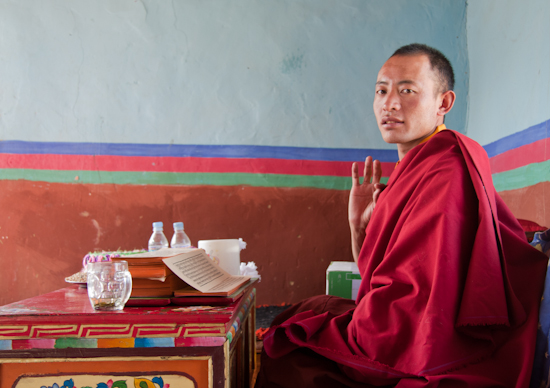
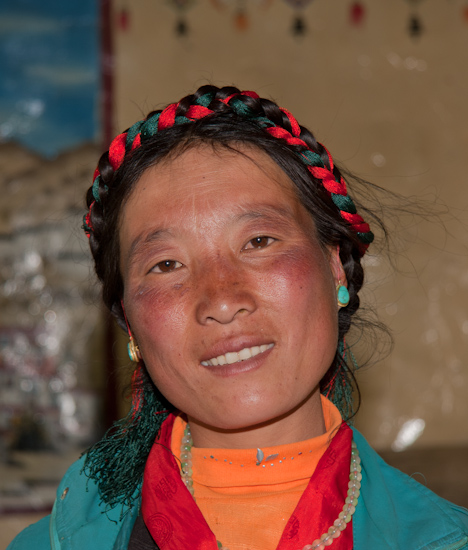
I went back later to see if I could photo the two women who brought us our beer. I looked in on the monk and he motioned for me to sit next to him, he had been chanting and reading for quite some time.  I sat there and listened, then showed him my camera.  He was most interested.  I took several photos, and he couldn’t get enough of looking at himself on my camera.  I also convinced one of the women to have me take her photo – she was very shy, but finally she got into it!

May 28 – Today’s ride was only about 50 miles, with a 12-mile climb of 1,300 feet topping out at 14,800’.  We camp tonight at 13,500’.

The weather today was fantastic, warm, blue skies, almost no wind.  Though, sitting here now in my tent, it’s raining, and a wind has kicked up.  Everyone is praying for good weather tomorrow.

Just around cocktail time at camp we were surrounded by a hoard of children all 8-12 years old.  They were very interested in us, and particularly our cameras.   Posing for us was not a problem.  The boys were kicking the soccer ball, the girls were playing jump rope games that I remember seeing girls play when I was a kid.

Cycling Day 5: Of Yak Dung Walls, Yak Bling, and Interesting People

•May 25, 2011 • 2 Comments

Today’s ride was flat.  No, I mean really flat.  We cycled 60 miles down the fertile river valley.    This stretch of road had the most interesting Yak Dung covered walls I’ve yet to see.  Truly works of art.

This guy looks like he’s cycling out of Las Vegas after a day at the slot machines.

This man was sitting on top of some bags of grain that were stacked on a small trailer pulled by a even smaller tractor which had a horrendous water leak coming from somewhere in the vicinity of the engine.  They would drive the tractor about 300 yards, stop, go to the irrigation ditch running along the road and fill up a bucket, pour it into the tractor, and do it again 300 yards later.  It was a very slow and painful process to watch.


This farmer was plowing his field, singing the whole time, and apparently thoroughly enjoying his work.   Can you imagine dressing up your farm animals any more than this?  It’s not as though these are animals in some tourist district posing for photographs.  They are working!  Further down the road I saw some Yak with Tibetan Prayer scarfs around their necks.  Very chic!

Cycling Day 4: Awakening to Snow

•May 25, 2011 • 2 Comments

I now know why there was such a large military presence in Lhasa.  July is the 60th anniversary of the “liberation of Tibet from the oppression of the D.L.” (no Orwellian language there!)  Given that there was an uprising in 1998, I guess they are over preparing for the upcoming festivities.  No American or French visitors will be allowed into Tibet during July, except for a few special exceptions.  Apparently people from those countries are sympathetic to the D.L. and his cause (I can’t use the name because people who have, have had their internet access shut down).

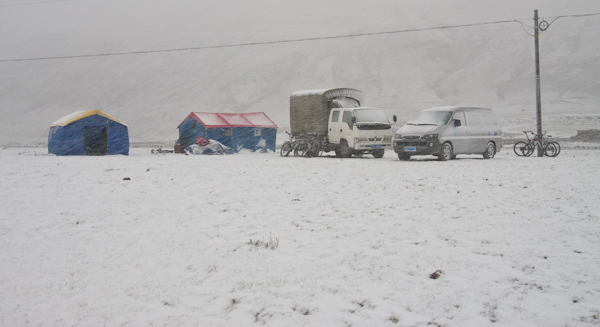
We camped on the edge of a sheep-herding field, so I was expecting to wake up to sheep surrounding our tents. Instead, we woke up to snow. It was cold and blowing. The prospect of getting on a bike in this was not something I was looking forward to. Our guide agreed that it would be too dangerous, so we waited in the dining tent for a few hours. Once the snow stopped, we headed out. The ride was relatively easy, about 40 miles, and it turned into a pretty nice day, except for a bit of hail, and some rain, and, oh yes, a headwind that would have made my fellow Santa Fe riders take notice.

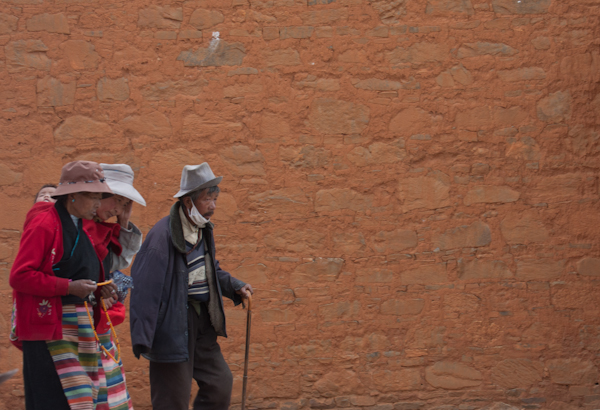
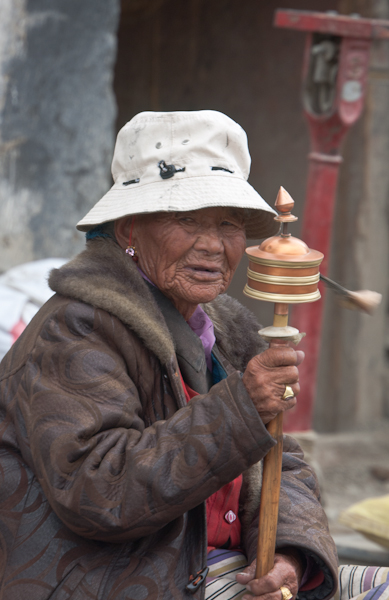
The people here have some of the most amazing looks.

This woman was very patient with me; though, I did have a very long lens, so I wasn’t in her face.  And quite a face it is.

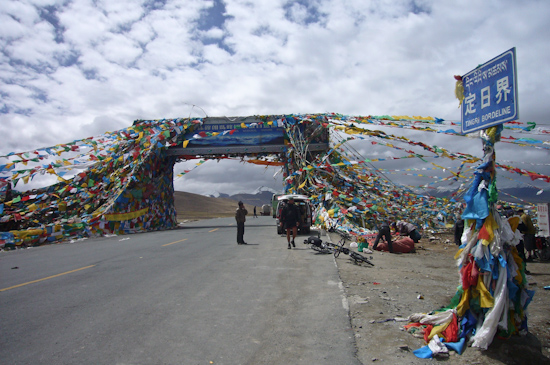
At every pass there are prayer flags attached to everything and anything.  Also, cars that crest the pass will toss out small paper prayer flags (about 2″ square) that come floating down as the car speeds down the other side.

A (profile of a ) castle (not a monastery) in Gyantse, which like many small towns is completely torn up for the July festivities that accompany the 60th anniversary of the “liberation”.

Cycling Day 3: Cycling to 16,650’

•May 25, 2011 • Leave a Comment

Our ride today started at the campsite elevation of 15,000 ft. We cycled up to 16,650′, but from that starting point it’s relatively easy as long as you go slow and don’t try to turn it into a race. Riding up to that elevation was easier than getting off the bike once there and walking around. The climb was only 6 miles, and the overall ride was 48.

If you look to the left, you can see th road we came up.  Unlike hill climbs I’ve done in other places, you normally can’t see the upcomming pass when you’re climbing over a thousand feet.  Not in Tibet, you can see what’s ahead of you from the beginning of the climb, sometimes thousands of feet up.

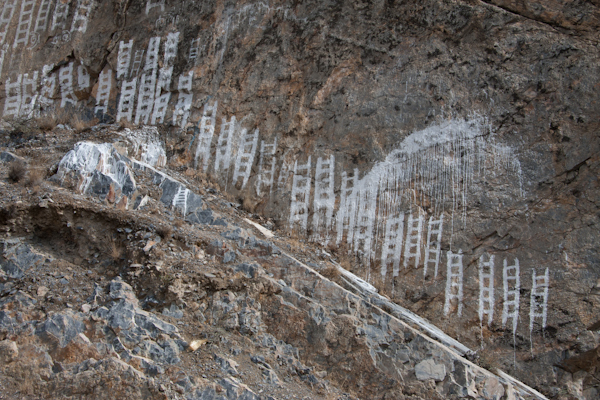
These stairways to a higher plane are painted on the sides of rocks all along the roads.

Something tells me she does not know what her hat says.

Gotta do the daily prayer flag photo.

The arrangements of drying Yak dung bricks are works of art.  I’m sure Alison could figure out an installation with them!

The Chinese are fascinated by us.   I’ve had my picture taken a hundred times in just a few days.

Cycling Day 2: A Big Climb onto the Tibetan Plateau

•May 25, 2011 • Leave a Comment

[this is on a Chinese computer in a VERY seedy internet cafe, I’m the only person not smoking, and the the keyboard is anything but what I’m used to, so if spelling or punctuation is wrong, you’ll know why… plus under the best of conditions, I’m a lousy speller… and its REALLY dark in here]

Our camp today was at the base of the day’s big climb, to get us over a pass and onto the Tibetan Plateau.  The climb was 17 miles and 4700 feet of climbing with a maximum altitude of 15,900 feet.  The total day was 50 miles, all the rest being mostly flat after the climb.   The Tibetan Plateau in the area of our riding is consistently around 14-15,000 feet, so that will be our base altitude for the next 10 days, with climbs taking us to 16 to 17,000 feet.

Today’s camp is on a large plain along the lake.  The wind is howling.  I hope the support crew hammered the stakes in securely or we’ll end up across the lake. 

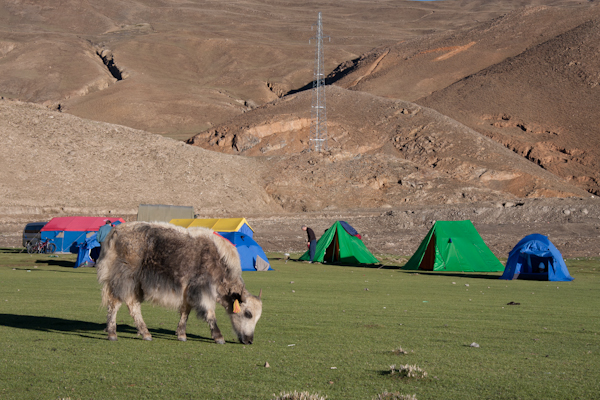
We woke up to a bunch of Yak around our tents. They are very skittish animals, so the slightest movement sets them running. 

Speaking of Yak, the Tibetans like to use a lot of Yak Bling.

This is our toilet tent, there was not a lot around us.

Lhasa, day 3, acclimatization complete!

•May 20, 2011 • 2 Comments

In Lhasa, the city police, military, security police, and several other uniformed, gun-toting officials makes for a very weird experience while walking around.  It’s impossible, and I mean absolutely impossible to walk for more than a few minutes without seeing groups of uniformed officers.  The military travel in groups of five, one carrying a rifle, one a fire extinguisher (presumably NOT to put out fires).  Others travel in larger or smaller groups.  There are armed guards in front of every official-looking building, of which there are many.   And tonight I saw 20 police with full riot gear: shields, helmets, and batons.  A riot in Lhasa?

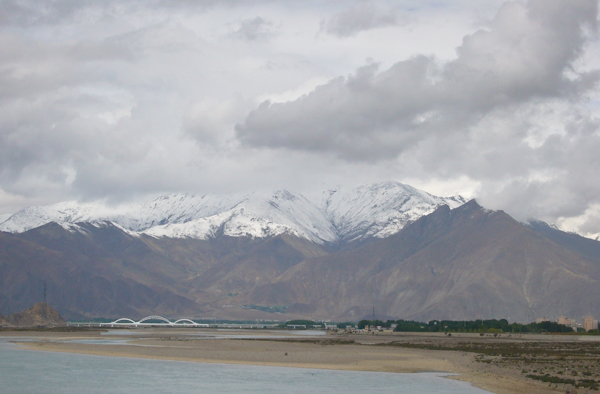
Today I was cycling over a bridge and stopped in a pedestrian pull-out area to take this innocuous photo of the snow-capped mountains down river.  An army guard appeared out of nowhere and started yelling at me (in Chinese) and pointing to my camera.  Apparently there is a restriction on taking photos of mountains from bridges, I guess. Anyway, it’s all very creepy.

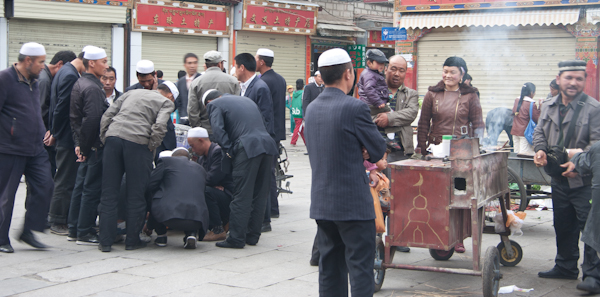
There is a Muslim section of Lhasa with all the butcher shops.  Apparently Buddhists don’t approve of the killing of animals, so that job is relegated to the Muslims.

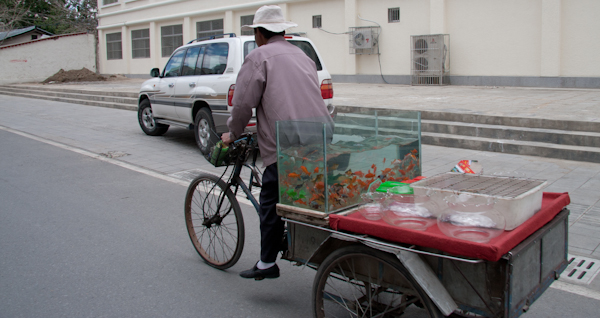
Look closely, not a great photo, but I had to shoot fast.  Lhasa is filled with people riding bicycle carts selling or carrying every imaginable item.  But selling goldfish?  Now that’s original.

We visited Braille Without Borders for a tour of their small school.  It’s quite an amazing story of how a blind German woman traveled to Tibet in the 80’s by herself to set up a school for blind kids.  In Tibet, and China, blindness was, and in many rural areas still is considered a curse.  Children were often locked in their rooms or worse, tied to their beds.  Our guide, as a child, was not allowed even to dress herself because her parents said she was not capable.  The are not allowed to attend school with sighted kids even to this day in rural villages.  This charity helps educate them, and it’s quite a moving experience to see.  This little girl sang a song for us in an amazingly strong voice for such a small person.

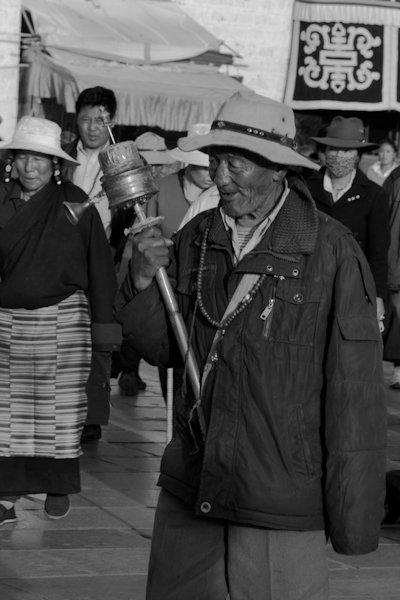
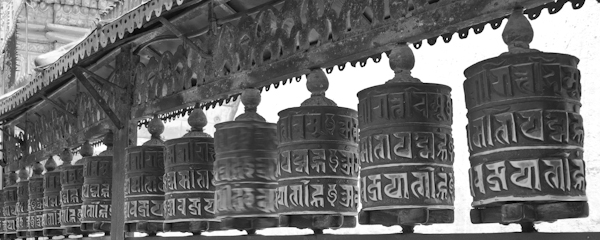
The wall behind the Potala Palace has over a thousand prayer wheels.  This line of wheels goes on and on and on with a constant stream of people praying and spinning.

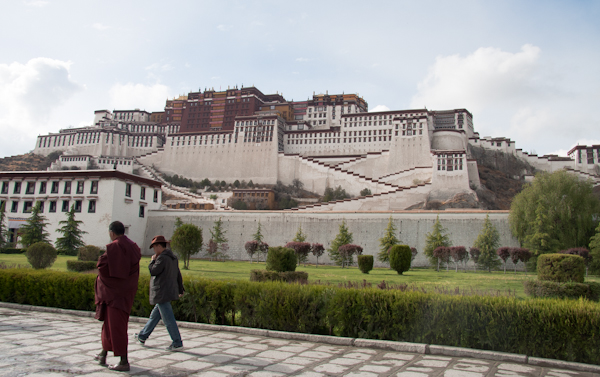
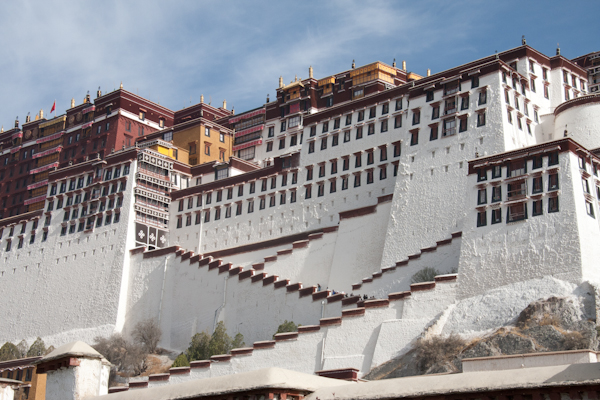
The front of Potala Palace

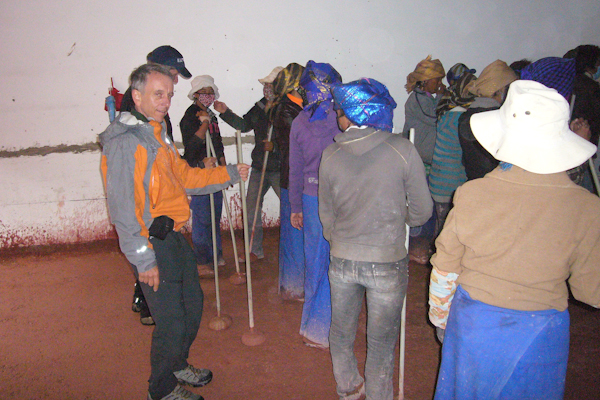
These girls were singing songs and tamping down the dirt floor. They invited us to participate.  I’m not sure how efficient it was, but it certainly made for good theater.

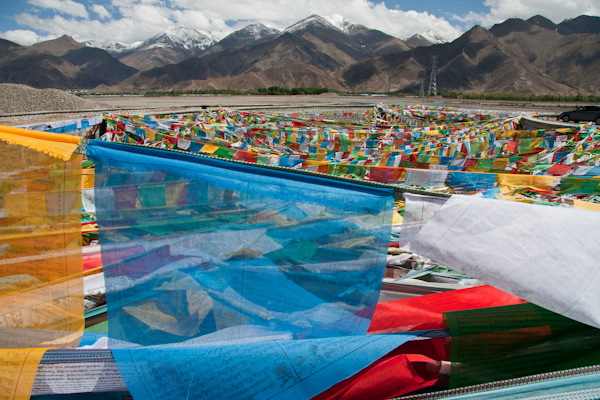
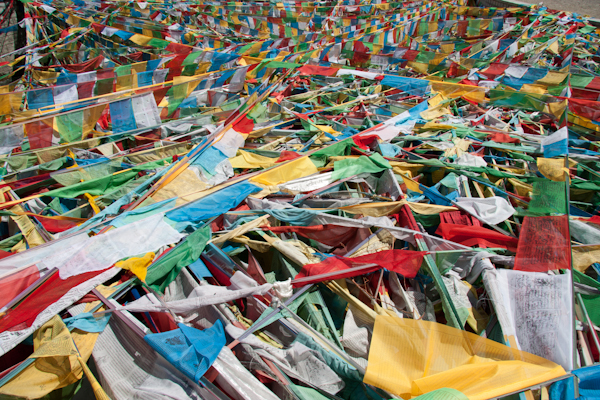
Now I expected to see a lot of prayer flags in Tibet, but the shear quantity in this spot was something.  These flags are over a spillway that connected to the Lhasa River.  I’m sure there is some significance to this spot, but we couldn’t figure it out.

Lhasa, Tibet

•May 18, 2011 • Leave a Comment

Lhasa couldn’t be more different than Kathmandu.  The major roadways are new and clean of litter.  The vehicles follow the speed limit with a frightening obedience.  Actually, the best I can figure, everyone constantly follows all the rules with strict compliance.  And unlike India (or Belgium) where there are lots of rules but no enforcement or adherence, in China there are even more rules, and everyone follows them, always.  It’s like being in a giant ant colony.

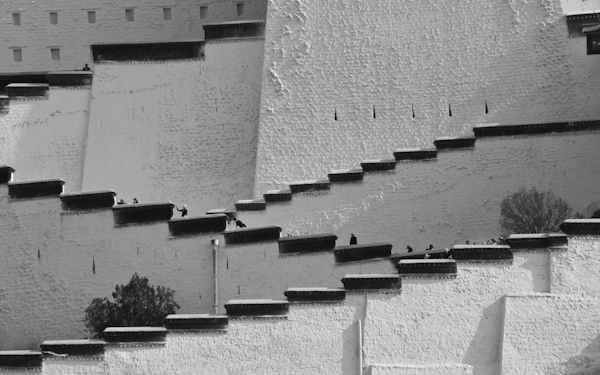
We went to the Potala Palace today.  It’s an amazing place in size and grandeur.  You can only visit it with a guide, and then only after making a pre-arranged appointment.  You get a 60-minute time slot, and if you are a few minutes late, you forfeit your time.  We had to hand over our passport to our guide for the duration of the trip, and were only given it back at the end of the tour.

The view from my hotel room.

Once inside there are no photographs, one can not wear sun glasses (even though who would want to given how dark it is), no hats (I asked why no sunglasses and hats, and the guide said it was because Buddhism didn’t allow it… now I’m no student of Buddhism, but really?), no water (but you could buy some after you when through an airport-like screening).  We were told by our guide to not ask too many questions because he would not want to be slowed down because the security police would constantly be telling us to move along (which they were).  He told us to not talk about politics, or heaven forbid we mention The D.L. #14 by name, you know, the one that if I put his name in this post my Internet access will most likely be shut down.

All that aside, it was worth the visit.  The palace is more than just a museum.  There are a lot of tourists, but there are just as many people there to pray, add Yak butter to the massive candles that are everywhere; there is chanting, and incense burning.  It’s a very special place, but unfortunately, the Chinese make sure you enjoy it as little as possible.


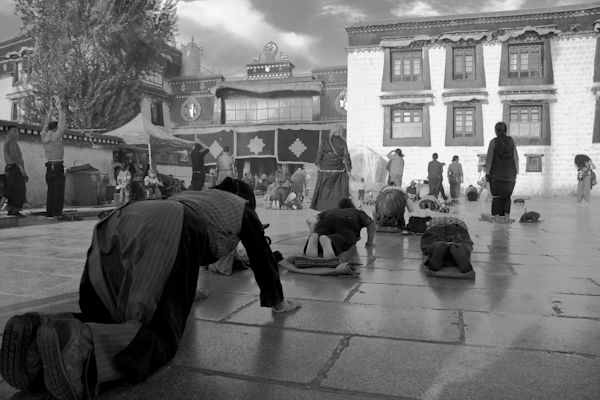
Pilgrims prostrating as they approach the palace.  This is a very painful looking experience.

Kathmadu, day 2

•May 17, 2011 • Leave a Comment

Kathmandu is a lot like Delhi – noisy, polluted, the streets are jammed to the edges with pedestrians, cars, motorcycles, bicycles, and bicycle rickshaws.  Horns are constantly blaring.  Litter of every imaginable sort blankets the edges of the roads, the medians, and well… everywhere.  However, it has a certain appeal, in an insane, in-your-face, hectic sort of way.

Despite all that, the people are very friendly, and will usually give you a gentle smile.  It seems very safe, and other than an occasional beggar, taxi driver asking if you need a ride, or someone selling some little trinket, the people are not too bothersome, and are certainly not threatening.

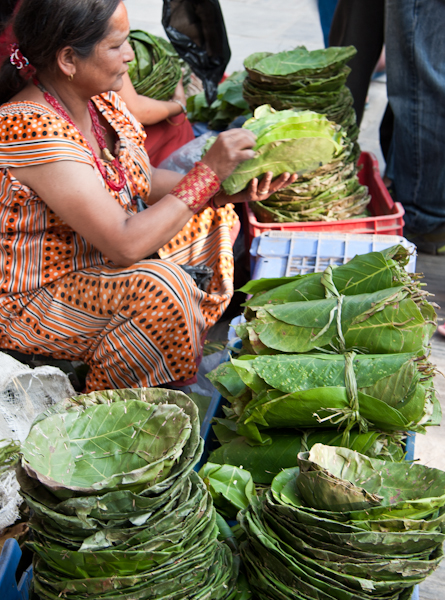
Bowls made from leaves.

Don’t ya’ love the sneakers?

Kathmandu, day 1

•May 15, 2011 • 2 Comments

Kathmandu:  we just finished experiencing one of the infamous “load sharing” rolling blackouts.  Apparently this will happen randomly for as much as 6-10 hours a day.  Fortunately, my hotel has a generator.

I have no idea what this nicely dressed woman was doing walking across the scaffold planking.

The number of wires overhead staggers the imagination. Now tell me, how in the hell is this guy able to figure out which wire he’s supposed to be working on?
This woman could not have stood more than 36″ tall.  She was sitting next to the road, and not overtly begging.  I gave her some money and asked if I could take her picture.  She was happy to accomodate.

Welcome to India

•May 14, 2011 • 1 Comment

It’ quiet outside my Dehli hotel this morning, unlike the insane caos of last night.

I’m off…

•May 12, 2011 • Leave a Comment

I leave tomorrow for a 7-week journey that begins with a 3-week bike ride from Lhasa, Tibet to Kathmandu, Nepal. Then, it’s some trekking in Nepal, followed by two weeks in northern India (Rajasthan).  I’ll be posting photos here on my travel blog; though, given the remoteness of the bike ride, I suspect broadband access will be limited.

Namaste!

Cusco – An Annual Fair and other stuff

•July 1, 2009 • 2 Comments

It’s kinda like a state fair in the US, only there are Guinea Pigs being roasted and there are more varieties of potatoes then you can imagine.

Neither of these guys look very happy.

Cusco_7-1 (9 of 11)

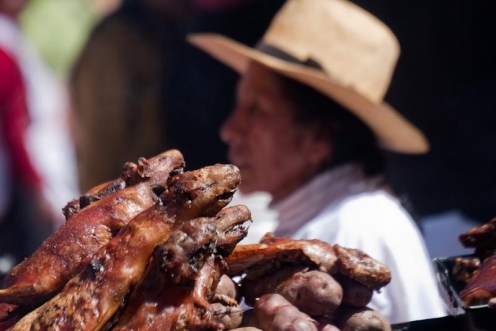
These are “cuy”, or Guinea Pigs.  It’s a Peruvian staple.  Looks too much like a rat for me to even consider eating it.  And the people I’ve talked to say it’s definitely an acquired taste.   I’ll save my taste buds.

Cusco_7-1 (2 of 11)

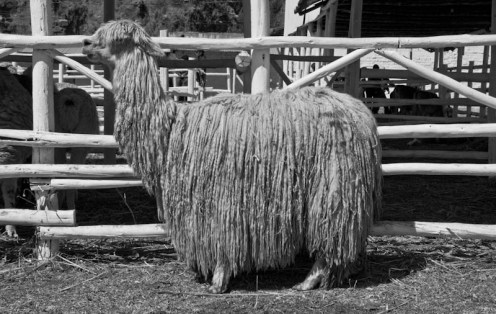
I’m not an Alpaca expert, but this Rasta-paca has quite a look.

Cusco_7-1 (7 of 11)

Cusco_7-1 (6 of 11)


There were judging contests with awards given for the best animals.  Afterwords, they sold them at auction.

Cusco_7-1 (4 of 11)

Cusco_7-1 (5 of 11)


Yes, Peru is the home of the potato.  They say there are approximately 4,000 varieties.  I think that is either Peruvian folklore, or some esoteric definition by a highly detailed botanist.  However, even if there are not 4,000… there sure are a lot.  This display continued at 90 degrees to the left.  Lots of potatoes.

Cusco_7-1 (10 of 11)


Just because I liked the lamp post.

Cusco_7-1 (1 of 11)

Street scenes in Ollantaytambo

•June 27, 2009 • Leave a Comment

I took these photos on my morning walk into town the other day.

Scenes from Ollanta (2 of 9)

Notice the red bags on the end of the sticks.  This means the “establishment” sells chica, a Peruvian drink that´s offensively bland.  Apparently, enough of it will make you drunk.  These two patrons stumbled out of the “bar” and took a pee on the building.  Then returned inside for some more.

Scenes from Ollanta (4 of 9)


A broken down taxi.

Scenes from Ollanta (7 of 9)


Seems like people, even children, are constantly hauling something on their backs, especially corn stalks. Scenes from Ollanta (1 of 1)


The people are very intersting. Scenes from Ollanta (1 of 9)


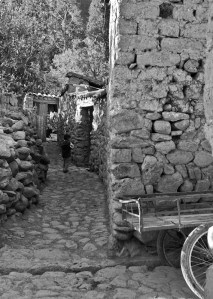
Scenes from Ollanta (3 of 9)One of the many interesting streets.

Winter Solstice

•June 26, 2009 • 3 Comments

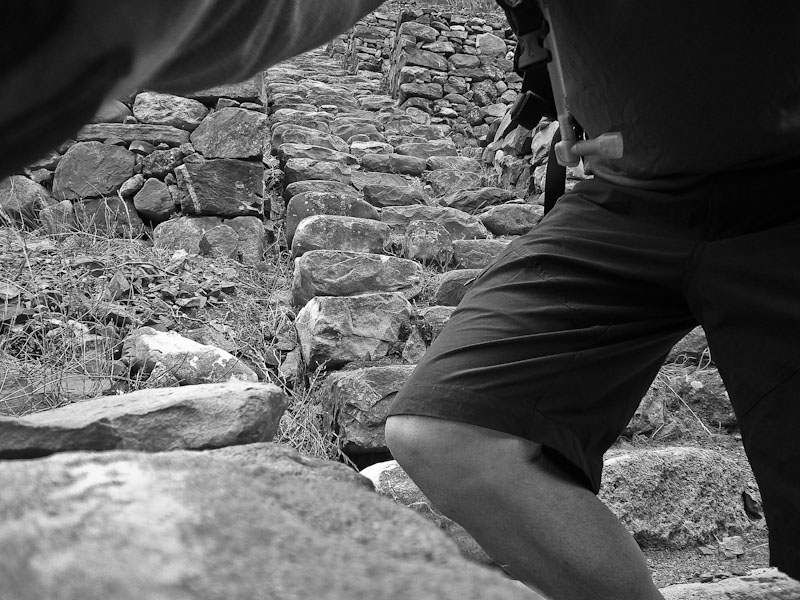
On the solstice, we got up at 4:30 and hiked up the mountain to see the sun rise.  When the sun hit the valley floor, it illuminated a “pyramid” that is shaped into the landscape but can only be seen from about 1,000 feet up. 

Solstice (1 of 2)


Solstice (2 of 2)

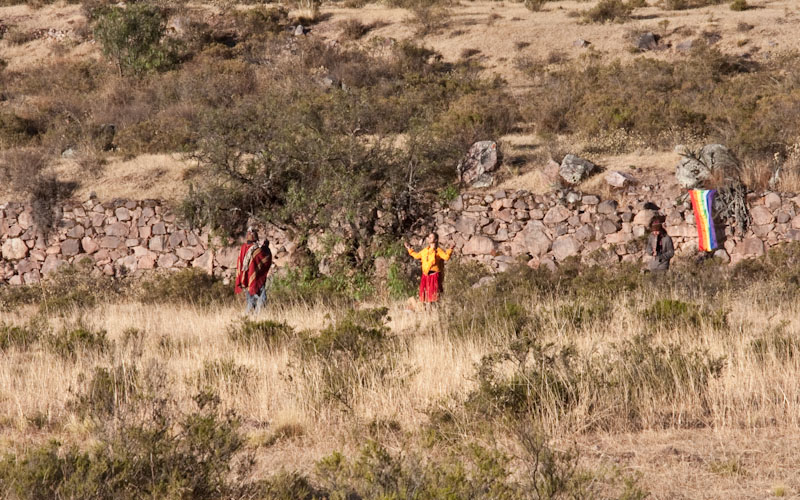
Sun worshipers


Pisac – ONE more ruin

•June 26, 2009 • Leave a Comment

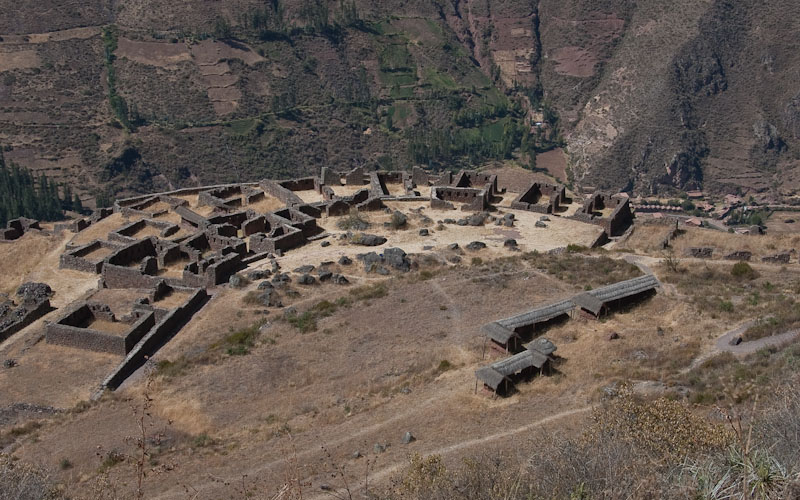
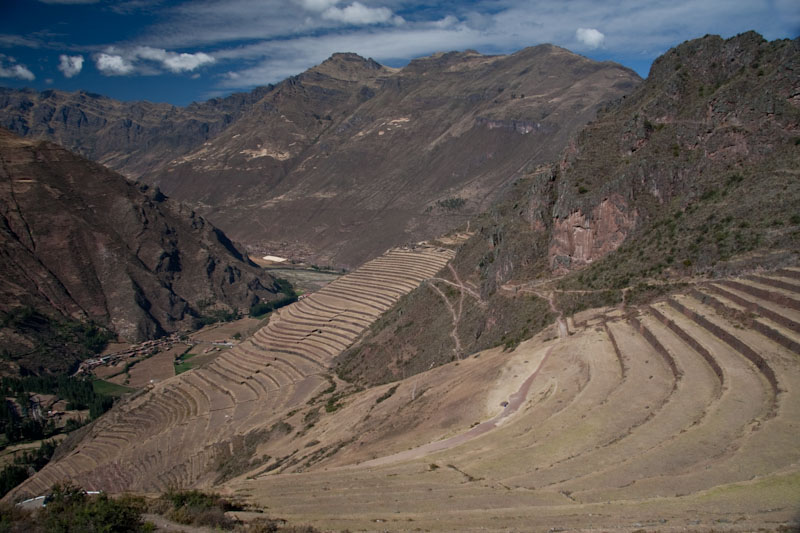
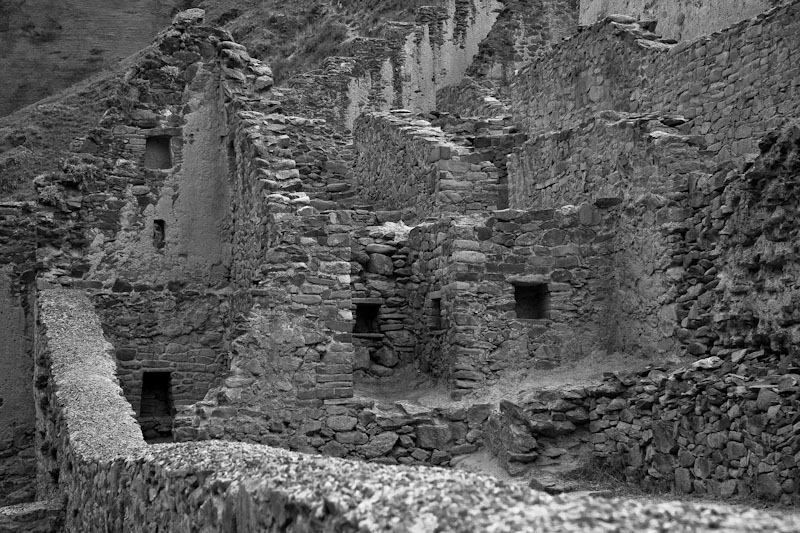
OK, I lied, I forgot to include some photos of Pisac, which was an amazing set of ruins and terraces, and there were hardly any tourists. 

Pisac (5 of 5)


Pisac (2 of 5)

Ollantaytambo Ruins

•June 25, 2009 • 1 Comment

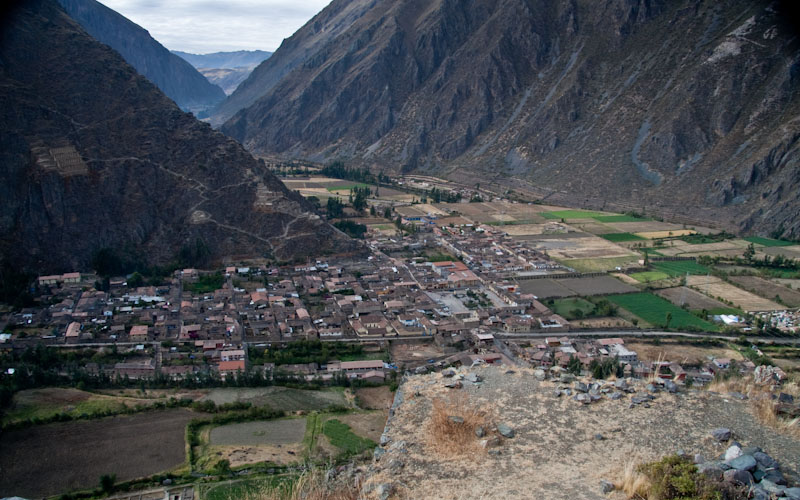
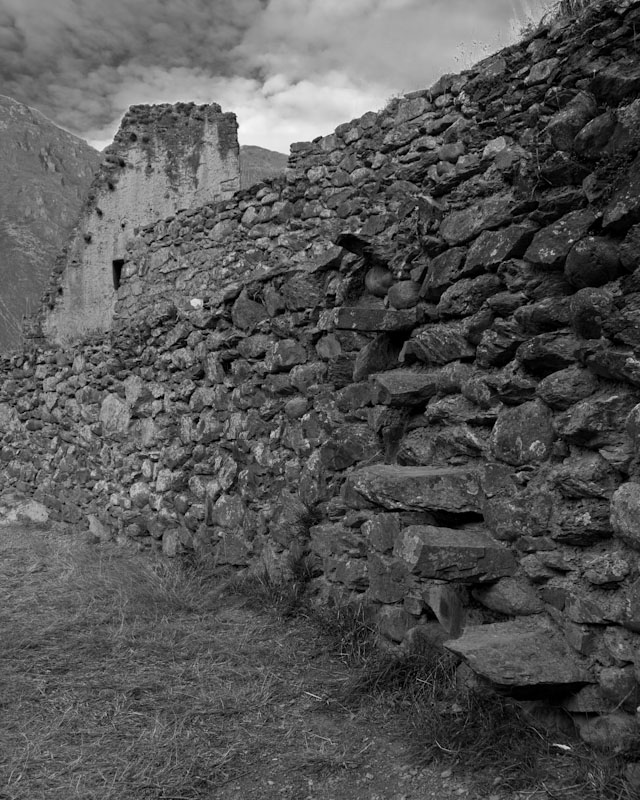
Below are some photos of  the large ruins above Ollantaytambo.  Certainly not of the Machu Pichu scale, but they are impressive nonetheless. 


The Market that Time Forgot

•June 19, 2009 • Leave a Comment

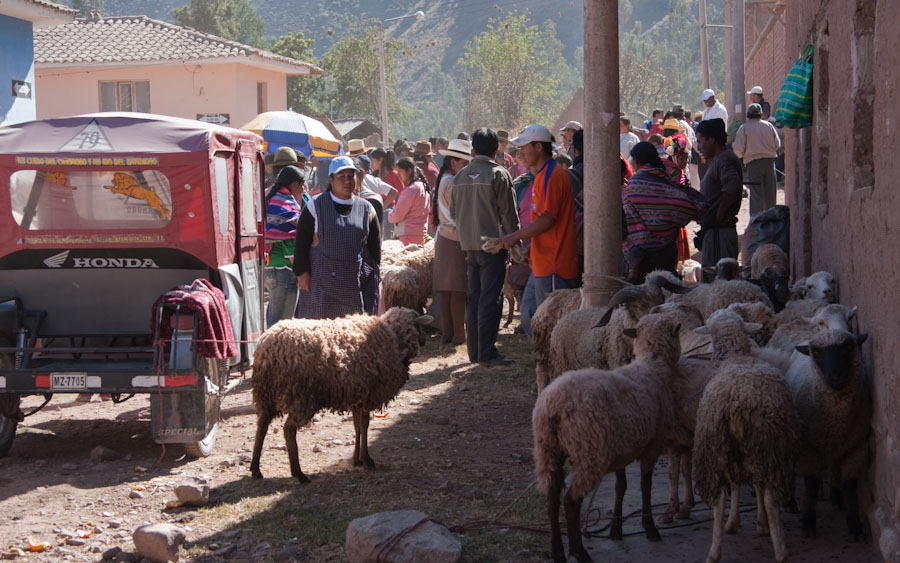
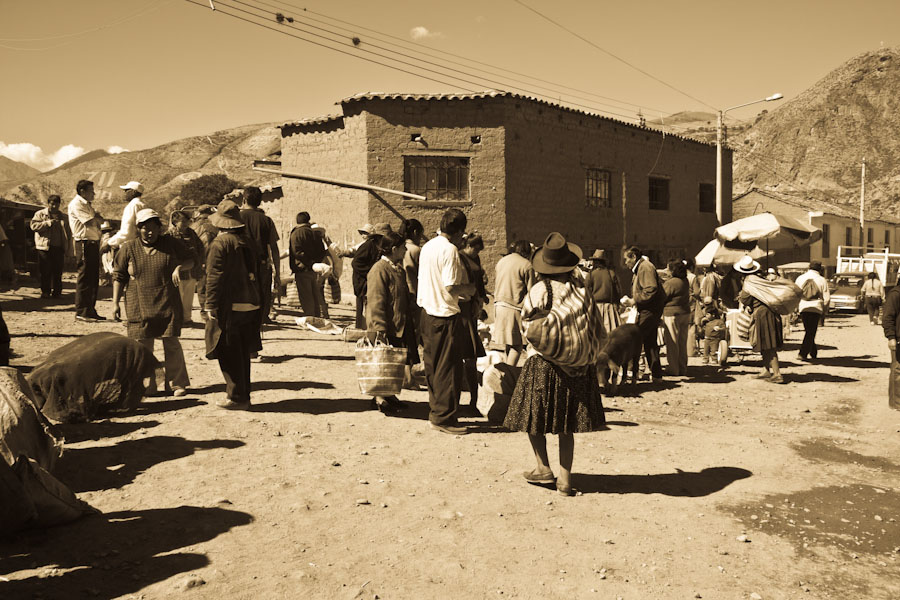
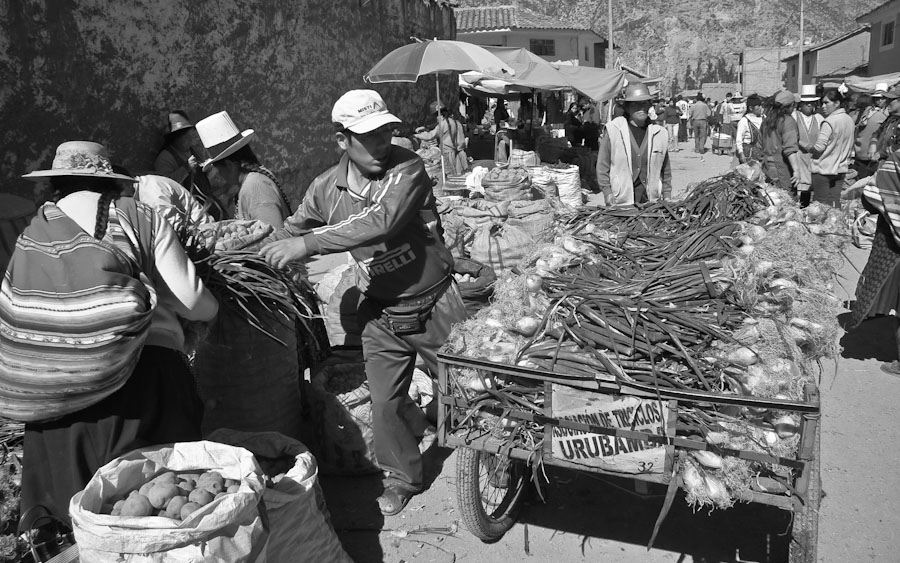
There is a weekly regional farmers market in the town of Urubamba, which is about a 20 minute drive by “combi”.  The combi’s are essentially mini-vans that operate as taxi’s/busses.  The seat 12, but the one I was on started out with 16 people, then the driver decided to pick up a few more riders along the way (hence the role of bus) pushing the total to 20.  When we came to a slight incline of no more than 2% the vehicle could hardly make it up the hill.   I was the only gringo.

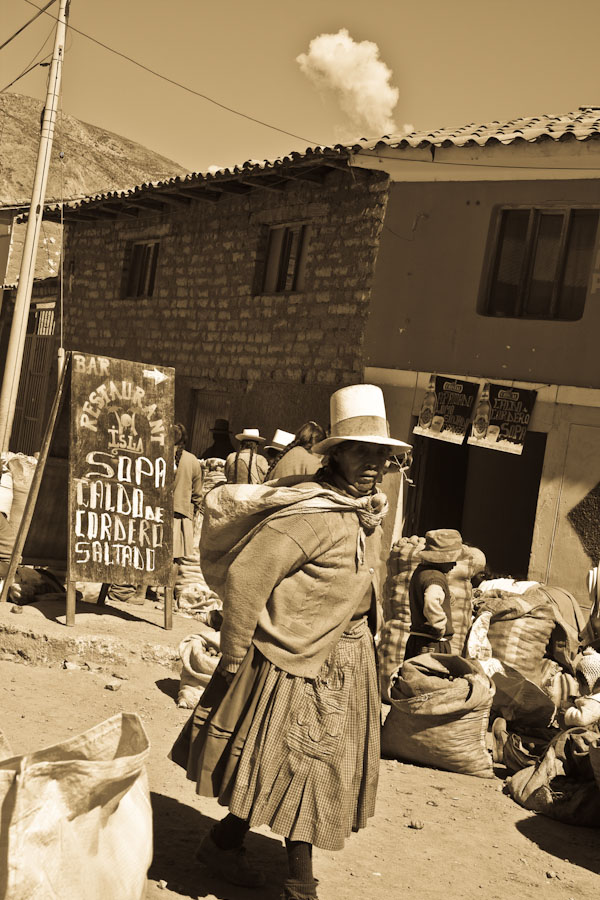
The regional market was like a walk into the past.  Most of the scenes could have been 25, 50, 100, or even 150 years ago.   In many ways, the Peruvian Andes are a place where time has stood still.   I walked around the market for an hour or so, and did not see one other tourist, gringo, or person with a camera.  


Scenes from my home-stay environment:

•June 19, 2009 • Leave a Comment
Homestay-1
this is looking at my bedroom window

Homestay-2

this is my bedroom.  The floor is rough concrete… basically compressed dirt and concrete.  Drop something on the floor and it’s instantly dirty.  Everything is always dirty.  Put some clean clothes on, and they will be dirty within 20 minutes. 

Homestay-3

my bedroom from the other direction.  Electrical lines are exposed, one outlet, adobe construction, no heating…very posh.  My wall is adjacent to the indoor kitchen (there’s one outside as well) but the wall is not fully filled in, so I hear everything.  I thought our house in Edmonds was privacy free… not even close.

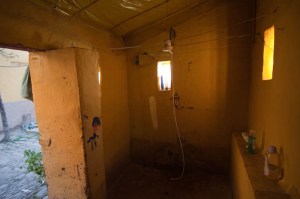
Homestay-4 the infamous shower.  Note the exposed 220-volt circuit breaker switch to the left of the window.  There is a door (of sorts), but it’s just slats of split tree branches.  One does not want to touch those lines above the shower when the 220 is flowing to the white heater while the water is running.  At best it produces a trickle of tepid water.  And given there is no glass in the windows and the door is basically open, taking a less-than-warm shower at a 9,500 foot elevation in winter makes for a exceedingly fast process.   The experience is so unpleasant that I’m now taking showers every other day and doing a sink wash with hot water that’s boiled (there is no hot running water) on my off days.  Shaving is now every other day.  I have to think of this as a variation of camping.  The family I live with takes a shower once a week.  I certainly won’t go there… but that’s how everyone here lives. 


Homestay-5

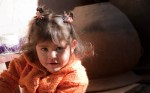
Paola – she’s very cute, if not a bit spoiled.  Understandable, because her brother Gabriel can be quite the tormenter.  He poured milk on her head at dinner last night.  Apparently Peruvians are notorious for the inability to discipline their children. 

 Homestay-6

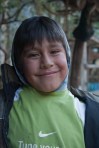
Gabriel.  Nice kid in a pain in the ass sort of a way…and a bit of a character at times.

Homestay-7

 Maize and a variety of Peruvian potato.  They are everywhere, and end up in the soup on a regular basis.  They are very good. 

Homestay-8

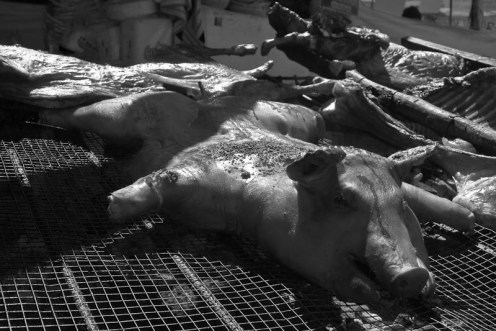
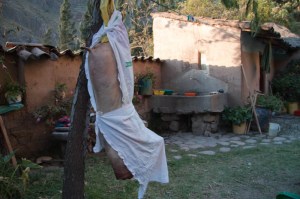
Yesterday morning when I came out of my bedroom (which is just to the right – the bathroom is the small building in the background which is directly across from my bedroom) Jose’s sister was at the sink along the bathroom building wall. She was washing some entrails.  Then I noticed the pig hanging on the tree.  I guess there will be one less squeal in the pen in the side yard. 

 Homestay-9

The outside kitchen.  Can you guess what’s cooking under the white plate?  Yup, it’s pork.  And it did not come from the local mercado.  They use the corn husks as fuel.  They are a surprisingly efficient energy source: almost no smoke, no discernible oder, and they burn fairly long.  The other pots are boiling our drinking water.  

Homestay-10

Well, the pig moved from the courtyard to the living/dining room.   One can only imagine where he’ll go next.  My bedroom is out of the question!

 We had the pig for dinner.  It was very good.  It´s no longer hanging in the living room.

Scenes from another bike trip

•June 13, 2009 • Leave a Comment

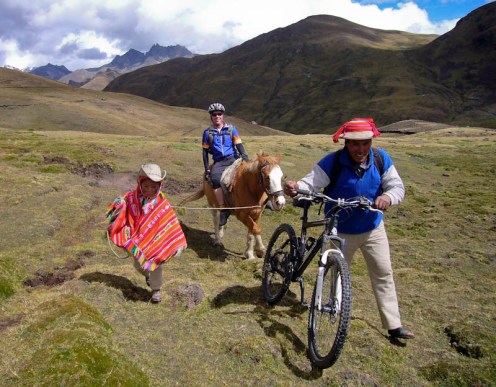
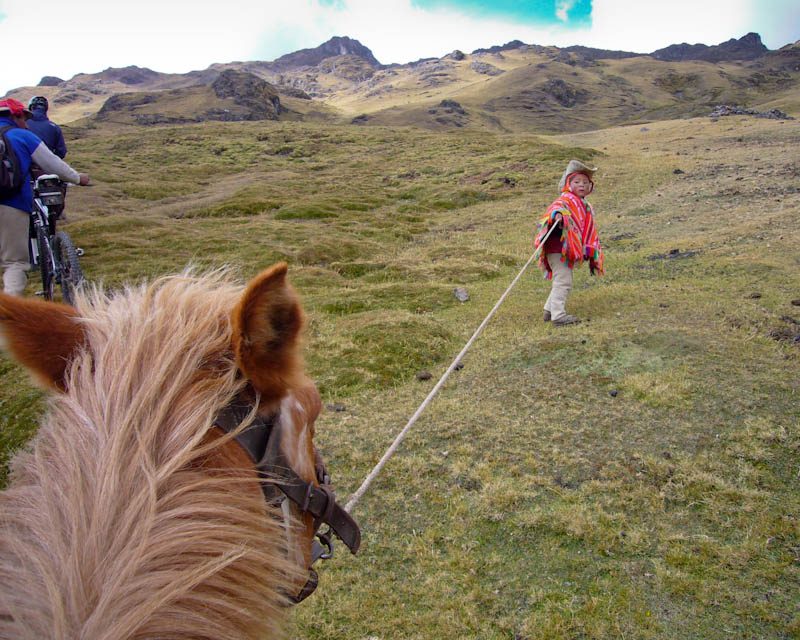
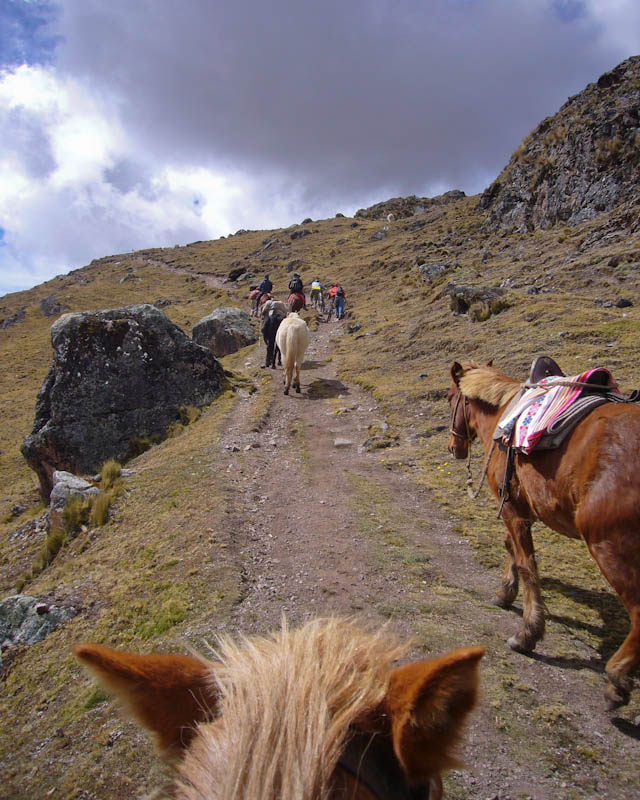
The trip:  a van shuttled us and our bikes from Ollanta (9500 ft) to 12,000 feet where we met our porters and horses.  The trail (where there was one) was taking us to 15,000 ft.  Most of the riders immediatly got on the horses and had the porters push or ride their bikes.  Me and one of the guides decided to ride up as far as possible.  I made it to 14,250 feet.  Anything below 14,000 feet is not a big problem for me, but the physical difficulty is exponential after that.  At 14250 i needed to get on a horse.  Hold on for the next set of photos, because, i´m not really a ¨horse¨guy.

Cycling_6-12-8

Cycling_6-12-11


I got on the horse, and I guess the look of anxiety crosses cultural barriers.  Hey, no hadlebars, no saddle (litterally), no pedals (once again, literally).  How the hell do you steer this thing?

Papa porter decided to give the horses lead rope to his son – of four years – to guide me. 

It was quite an adventure.

A few Ollantaytambo images

•June 13, 2009 • Leave a Comment

Ollanta_6-10-2

I sat down on a small alley in Ollantaytambo and the childern come out like moths to a fire.  They see a camera and are anxious to earn a few cents.

Ollanta_6-10-1


This was taken outsde the local market…

Ollanta_6-10-3